On September 30, the National Day for Truth and Reconciliation, we honour the children who never returned home from residential schools, survivors, their families and communities.
The day asks us to remember the truths of the residential school system and its ongoing impacts. It also asks what those truths require of us now, including from the organizations and systems that shape health and health care.
For the Rural Coordination Centre of BC (RCCbc), that begins with relationships, and meaningful relationships must lead to change. They should influence how we listen, whose knowledge shapes the work, how decisions are made, how programs are supported and how responsibility is shared.
The truths we are asked to confront are not only historical. Indigenous-specific racism and inequities in access, experience and outcomes remain part of health care in British Columbia. Reconciliation cannot sit alongside the work as a separate project. It must be reflected in how the work itself is done.
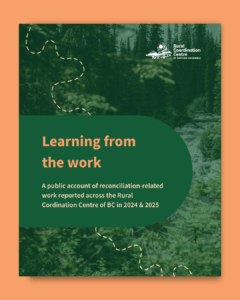
Today, RCCbc is sharing a reconciliation report that brings together reflections, examples and learning from 2024 and 2025. It offers a snapshot of work and relationships that extend beyond that period, not a starting point for them.
Much of what matters most cannot be fully captured in a report. But as RCCbc has grown, so has the need to connect what we are hearing and learning across programs, partnerships and communities, identify gaps and understand where greater attention or change may be needed.
The report is not evidence that reconciliation has been achieved. That is not ours alone to determine. What it can do is make some of our learning more visible and provide a stronger basis for deciding what needs to change next.
“RCCbc's commitment to Truth and Reconciliation, and to Indigenous Specific Anti-racism, is embedded in our learning, our work, our partnerships, and our allyship. Moreover, it is an explicit priority in all ways we show up to improve the health of rural, remote, and Indigenous patients and communities across BC. ”
This work is also entering a new phase. RCCbc for Inclusion, Social Justice and Equity (RISE) has supported organizational learning by challenging assumptions, creating space for difficult conversations, strengthening relationships and helping bring equity and reconciliation considerations into decisions.
RISE’s advisory committee has been stood down, while its internal leadership team continues and will take a new name. This transition represents an evolution of responsibility rather than a reduction of commitment. RCCbc is considering how structures and learning systems can support the next phase, how Indigenous leadership and knowledge can more directly inform decisions, and how reflection can lead to accountability and action.
“As First Nations physicians and leaders, we have learned that meaningful reconciliation begins with listening, but it cannot end there. It asks us to be willing to examine how our systems, decisions and assumptions continue to affect Indigenous people and communities today. In rural health, strong relationships are essential, but those relationships must be reflected in how power is shared, how Indigenous knowledge informs decisions, and how accountability is demonstrated through a willingness to do things differently when communities tell us they must be done differently.”
The responsibility now is to use what we are learning to guide what comes next.
That means changing how programs are designed, creating stronger ways for Indigenous knowledge and leadership to shape decisions, committing resources and support where they are needed, strengthening accountability in the work, and being willing to change our own ways of working.
On this National Day for Truth and Reconciliation, we share this report as one part of that responsibility: a record of where we are now, a tool for continued learning, and a commitment to carry that learning into decisions, relationships and action.
Read the report: Learning from the work
RCCbc’s reconciliation report for 2024 and 2025 brings together reported work across six connected priority areas, reflections on what the record shows and where it is limited, and an appendix connecting 24 programs to the review.