
A community vision takes shape
Whistler 360 Health is a community‑governed, not‑for‑profit primary care centre that grew out of years of planning and relationship‑building. In 2023, the society assumed administrative operations of the long‑standing Whistler Medical Clinic, with family physician Dr. Karin Kausky and community leader Carol Leacy as co‑founders, Karin as medical lead and Carol as board chair and acting executive director.
That long lead‑up meant the clinic launched with a clear, shared vision for a stable, community‑supported home for primary care. Two years in, there has been no staff turnover, overhead costs for providers have decreased, and team members describe the community‑led model as restoring joy and purpose back into daily work. “It feels like we’re building something that really belongs to Whistler,” says Karin.
Turning to team coaching
When Whistler 360 took shape, it brought together two groups that needed to function as one: a clinic team with its own established culture, and a community board that had spent years designing a new model. Leaders wanted transparent, fair ways of making decisions that everyone could see and trust, and they wanted staff, providers, and board members to all feel a part of “Whistler 360.”
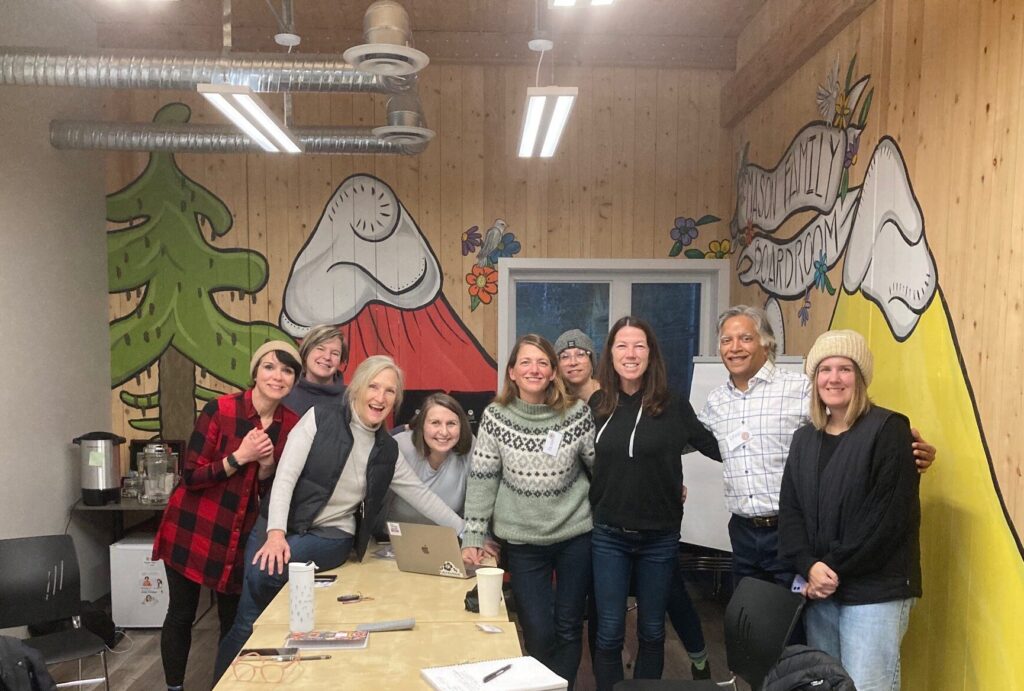
To support that, the clinic joined Quality Team Coaching for Rural BC (QTC4RBC), a six‑month program that helps rural teams strengthen relationships, align shared purposes, and build communication and problem‑solving skills for resilient teamwork. “We knew we needed help bringing the ‘old’ clinic and the ‘new’ vision together as one team,” Carol reflects, describing why they chose to participate. Their cohort included the practice manager and assistant manager, five providers (one nurse practitioner and four physicians), and four board members, with Karin bridging both worlds in both clinic and board roles.
“We knew we needed help bringing the ‘old’ clinic and the ‘new’ vision together as one team”
Making space for non‑transactional conversations
QTC4RBC’s structured approach combined evidence‑informed frameworks and facilitated dialogue, included a full‑day, in‑person workshop with four online sessions and three leadership sessions over six months. Some team members were skeptical at first, worried about role‑playing or unsure what to expect, but the in‑person day quickly became a turning point that still resonates.
Team coach Dr. Rahul Gupta saw his role as believing deeply in the team’s own capacity, curious about all perspectives and reactions as information about how the system works. This coaching stance—trusting that solutions lie within the team—is central to QTC4RBC’s philosophy. “My job wasn’t to tell them what to do,” he says, “it was to help them see the strengths and hidden dynamics that were already there.” Drawing evidence about high‑functioning teams, he introduced concepts the group could adapt, then stepped back so the team could decide what mattered most in their context and how to address them.
For Carol, the biggest impact wasn’t a specific policy or flowchart, but the chance to spend time together talking about things that weren’t purely transactional. “We rarely get protected time to talk about how we work together,” she says, so the group set aside questions like leases and accounting systems to focus instead on how they wanted to collaborate, make decisions, and build culture — exactly the kind of reflective, values‑based dialogue the program is designed to spark.
Building trust and psychological safety
Whistler is a small community where many people knew each other long before Whistler 360 existed, which helped lay the groundwork for psychological safety. Coaching sessions deepened that trust by creating a supportive environment where every voice from MOAs to board members was valued. The coaching program created a space where MOAs, providers, and board members could speak openly about what was working, what felt hard, and what they hoped the clinic would become, without hierarchy dominating the conversation.
Over time, Whistler 360’s vision, mission, and values shifted from abstract statements to everyday guides for decision‑making. The experience also highlighted how important it was to understand each other’s worlds; “we stopped thinking in terms of ‘board’ and ‘clinic’,” Karin notes, “and it started to feel like one organization.” Board members gained a clearer sense of the clinic’s day‑to‑day realities, while clinic staff better understood the board’s work and responsibilities. That mutual understanding made it easier to see everyone as part of one team.
Rekindling joy and strengthening team‑based care
For Karin, one of the most meaningful shifts has been the simple joy of working in a supportive, collegial environment. By developing stronger communication habits through QTC4RBC, the team navigated changes such as an electronic medical record transition and an influx of new providers, without fracturing relationships.
The MOAs emerged with renewed confidence and ownership. Inspired by the workshop, they began bringing forward their own ideas for improvements, and Whistler 360 has intentionally invested in upskilling them as core members of the care team. In a system where formal team‑based care structures are often limited, the clinic’s leaders are clear that “the MOAs are our team.”
To keep that sense of connection alive, Whistler 360 now holds regular clinic meetings with time set aside for open conversation, not just updates. Those ongoing habits of reflection and relationship‑building reflect what the team learned through the program: that quality improvement starts with quality relationships. “Those little touchpoints matter,” says Carol. “They remind us that we’re humans first, roles second.”

Better access, better experiences
As the community‑governed clinic stabilized staffing and added more providers, access to primary care in Whistler improved significantly. The clinic increased same‑day appointments and capacity to attach new patients, easing the burden on MOAs who had previously spent much of their time explaining why there were no appointments available.
In the first year, one of the MOA’s favourite tasks was phoning people on the waitlist to offer them a family doctor, calls that would sometimes move patients to tears. Now, there is no one left on the clinic’s list of patients seeking attachment.
Sharing lessons with other communities
In conversations with partners, Karin and colleagues are exploring how rural communities might be supported to map local assets and gaps, engage community members in health planning, and take first implementation steps with structured support. This aligns with QTC4RBC’s broader goal: to strengthen local leadership capacity and spread learning across rural BC.
Whistler 360’s journey reinforces how much is possible when leaders show humility, welcome challenges, and make time to talk about more than tasks. For Whistler, investing in Quality Team Coaching for Rural BC has turned a period of major organizational change into an opportunity to deepen connection, clarify values, and create a clinic where staff, providers, and community members truly feel they belong.
Quick facts:
- QTC4RBC is a coaching program that empowers teams to regroup and reconnect with their purpose and take steps toward building their desired team culture and advancing their chosen goals
- The program includes a one-day in-person workshop plus follow-up virtual team and leadership coaching sessions to build highly effective, collaborative teams.
- This program is for interprofessional rural teams (with physician involvement) in BC, who are ready to commit time and leadership support to improving how they work together and deliver care.
- QTC4RBC is an RCCbc program funded by the Joint Standing Committee on Rural Issues.